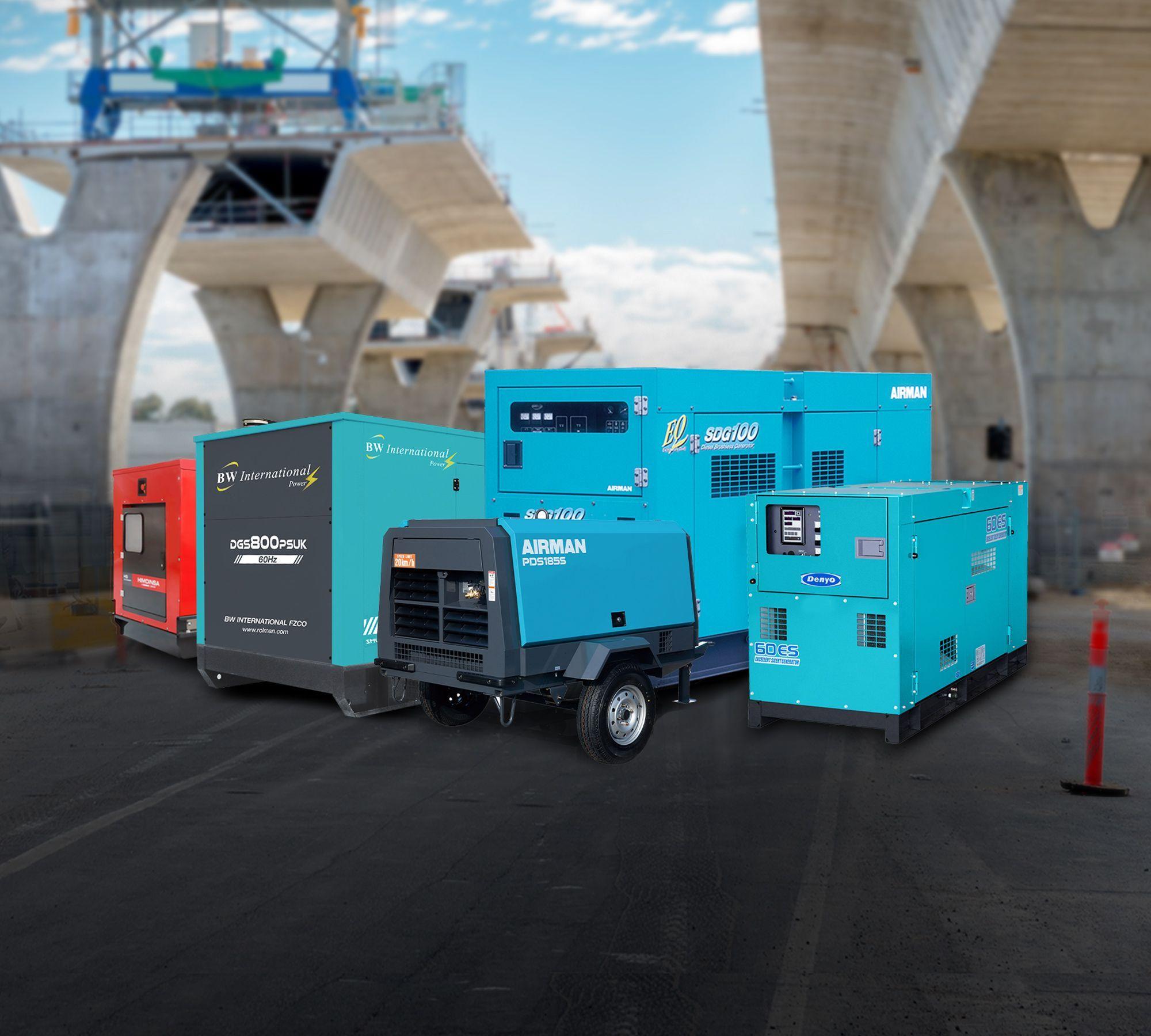
When working out how to size a diesel generator, most mistakes go one of two ways. A generator that's too small trips on overload the first time a large motor starts. One that's too big burns more fuel than the site needs and spends its life at light load, which harms the engine over time.
This guide shows how to size a diesel generator, from load list to final kVA rating, with a worked example for a construction site in the UAE. If you've been asking "what size generator do I need?", you'll have a figure to take to a diesel generator supplier in Dubai. For background, our earlier guide explains why generators matter.
Quick answer: the generator sizing formula
Generator size (kVA) = running load (kW) ÷ 0.8 power factor ÷ 0.7
Dividing by 0.8 converts kW to kVA, and dividing by 0.7 keeps the average load within a prime rating. Then check motor starting and site conditions.
Example: 80 kW ÷ 0.8 = 100 kVA of running demand, and 100 ÷ 0.7 = about 143 kVA for a prime-rated set, before motor starting is checked.
Sizing table: typical loads and suggested kVA
For a first estimate, find your running load in the table below. It applies the formula above, and the last two columns show the Denyo and Airman models whose 50 Hz prime rating meets each figure.
| Running load (kW) | Running demand (kVA) | Suggested minimum prime rating (kVA) | Suggested Denyo model (kVA) | Suggested Airman model (kVA) |
|---|---|---|---|---|
| 20 | 25 | 36 | DCA-45LSK2 (37) | SDG45S (37) |
| 40 | 50 | 71 | DCA-100ESI (80) | SDG100S (80) |
| 60 | 75 | 107 | DCA-150ESK (125) | SDG150S (125) |
| 80 | 100 | 143 | DCA-220SPK3 (200) | SDG220S (200) |
| 100 | 125 | 179 | DCA-220SPK3 (200) | SDG220S (195) |
| 150 | 188 | 268 | DCA-300SPK3 (270) | SDG300S (270) |
| 200 | 250 | 357 | DCA-500SPK (450) | SDG500S (450) |
| 300 | 375 | 536 | DCA-600SPK (550) | SDG610S (555) |
| 400 | 500 | 714 | DCA-1100SPK (1,000) | n/a (largest is SDG800S, 700) |
The table is a starting point. Like any generator size calculator in kVA, it leaves out three things that can push the answer up a size: which motors start and how, how many hours a year the set will run, and the conditions on site.
The table is a starting point. Like any generator size calculator in kVA, it leaves out three things that can push the answer up a size: which motors start and how, how many hours a year the set will run, and the conditions on site.
How to size a diesel generator in 5 steps
Step 1: List every load
Sizing starts with a load schedule: a list of everything the generator will power, with its running power in kilowatts (kW). Take the figures from the equipment nameplates or datasheets.
For each item, note whether it’s a motor and, if so, how it starts. Also note whether it needs a single- or three-phase supply, and its voltage and frequency, since these decide which set can power it. For motors, the nameplate kW is usually the shaft output, so the electrical input is slightly higher; use the input figure where the datasheet gives one.
Here’s the schedule for the mid-sized construction site used in the worked example, with illustrative figures.
| Bearing type | Running kW | Motor? | Starting Method |
|---|---|---|---|
| Tower crane | 45 | Yes | Variable frequency drive |
| Welding machines (4) | 20 | No | n/a |
| Site cabins and air conditioning | 25 | Yes (small compressors) | Direct on line |
| Dewatering pumps (2 × 7.5 kW) | 15 | Yes | Direct on line |
| Lighting and small tools | 10 | No | n/a |
| Total connected load | 115 |
Not everything runs at once. The share of the connected load that runs at the same time is the demand factor (often loosely called the diversity factor).
Step 2: Convert kW to kVA
Loads are listed in kW, but generators are rated in kilovolt-amperes (kVA), and the two are linked by the power factor. Three-phase generators are rated at a power factor of 0.8, so the kVA to kW conversion is kVA = kW ÷ 0.8, or kW = kVA × 0.8 in the other direction.
The result is your running demand in kVA.
Step 3: Allow for motor starting
Motors are the reason a generator can’t be sized on running demand alone. For a few seconds at start-up, an electric motor draws far more current than it does when running, typically six times its full-load current or more, and it stays high until the motor is close to full speed.
If the generator can’t supply that surge, the voltage dips, so lights flicker, contactors drop out, and sensitive equipment can trip. An automatic voltage regulator (AVR) helps the set recover from the dip, but the set still has to be large enough to supply the surge.
How a motor starts changes the size of the surge:
- Direct on line (DOL): full voltage from the first instant, so the full starting current. It’s the simplest and most demanding method.
- Star-delta: starts the motor at reduced voltage, which cuts the starting current to about a third of the DOL value.
- Soft starter: ramps the voltage up gradually. The surge depends on how the starter is set.
- Variable frequency drive (VFD): brings the motor up to speed under control, with the lowest starting demand of the four.
The sizing case is the largest motor starting while everything else is already running. On our site, the crane is the biggest motor, but it’s on a VFD. The harder case is a 7.5 kW dewatering pump starting direct on line. Where you can, stagger the starts so two large motors never start together.
Drives, inverter welders, and UPS systems also draw distorted current, which a generator handles less well than mains, so list them on the load schedule and tell your supplier, as they can call for a larger alternator.
Step 4: Choose prime or standby power
The same generator carries two kVA ratings, one for prime power and one for standby power, and the right one depends on how the set will be used.
- Prime power is for a set that is the main source of electricity, such as a construction site or remote operation with no mains supply. It can run for unlimited hours at a varying load, but the average load should stay at around 70% of the prime rating.
- Standby power is for backup when the mains supply fails, as in a hospital or office tower. The set runs only during outages, for a limited number of hours a year.
The standby figure is usually the higher of the two. Denyo’s DCA-1100SPK, for example, is rated at 1,000 kVA prime and 1,100 kVA standby at 50 Hz. It’s the same machine, so check which rating a quotation is based on before you compare kVA figures.
Step 5: Add headroom, but don't oversize
Leave room for the loads you expect to add, but don’t let the margin run away, because an oversized diesel generator has its own failure mode.
Engine makers warn that running a diesel set at less than about 30% of its rated output for extended periods harms the engine. This is wet stacking: at light load the engine runs too cool to burn its fuel completely, and unburnt fuel and soot build up in the cylinders and exhaust.
That gives you a band to aim for. The 70% average-load limit from Step 4 sets the ceiling, wet stacking sets the floor at about 30%, and a well-sized set spends most of its hours between the two.
If your load swings widely between day and night, one large set may sit below the floor for hours. Two smaller sets running in parallel, with one shut down at light load, often suit that pattern better.
Think beyond the current project too. A set sized for your typical site, rather than one job, can move to the next project, and rental fleets that match each set to the site’s typical load keep more of the fleet out of light-load running.
Worked example: a construction site in the UAE
Here’s the full calculation for the site from Step 1, showing how to size a diesel generator from load list to rating. All figures are illustrative.
Site: the load schedule from Step 1, with no mains supply.
- Running load. Connected load 115 kW × 0.8 demand factor (80% running at once) = 92 kW.
- Convert to kVA. 92 kW ÷ 0.8 power factor = 115 kVA running.
- Check the largest motor start. The hardest start is one 7.5 kW dewatering pump, direct on line.
- Running demand: 7.5 kW ÷ 0.8 = about 9.4 kVA
- Starting demand: 9.4 kVA × 6 = about 56 kVA
- Peak while it starts: 115 − 9.4 + 56 = about 162 kVA
- Apply the prime rating rule. The site has no grid, so the set runs on prime power, with an average load of no more than 70% of its rating. The 70% guidance applies to the average load over a day, so applying it to the running load, as here, errs on the safe side. 115 kVA ÷ 0.7 = about 164 kVA.
- Take the larger figure. The start check and the rating rule both land near 165 kVA. That’s the output the set has to deliver on site, so choose the next standard size up.
Three checks remain before ordering. The start check in line 3 is deliberately cautious, because a generator can supply a brief surge above its rating. How much depends on the alternator, so ask the supplier to confirm the voltage dip for your largest motor.
The crane’s 45 kW drive is also a non-linear load (Step 3), so tell your supplier about it, as it can call for a larger alternator.
Then look at the quietest hours. At night, this site may run only cabins and lighting, around 35 kW (44 kVA), which is below 30% of a 165 kVA set. The generator would spend long stretches at light load, so the two-set arrangement from Step 5 is worth considering.
Fuel use and run time
Once the set is sized, fuel becomes the main running cost. Consumption depends on load, not on the size of the generator alone, and the datasheet lists it at a stated load. The worked example above lands on a 200 kVA set, such as Denyo’s DCA-220SPK3, which uses 31.5 litres an hour at 75% load and has a 380-litre fuel tank.
Run time. Divide the usable tank capacity by the hourly consumption at your expected load. At 75% load, that set’s 380-litre tank lasts about 12 hours (380 ÷ 31.5).
Running cost. Multiply the hourly consumption by the hours worked and the diesel price. At 75% load, a 10-hour shift uses about 315 litres. At AED 4.80 per litre, the UAE price for October 2026 at the time of writing, that comes to roughly AED 1,510 per shift. The price is reviewed monthly, so rerun the sum with the current figure.
What to look for in the generator set
A few features decide how well a set copes with real site conditions, and they’re worth asking any supplier about.
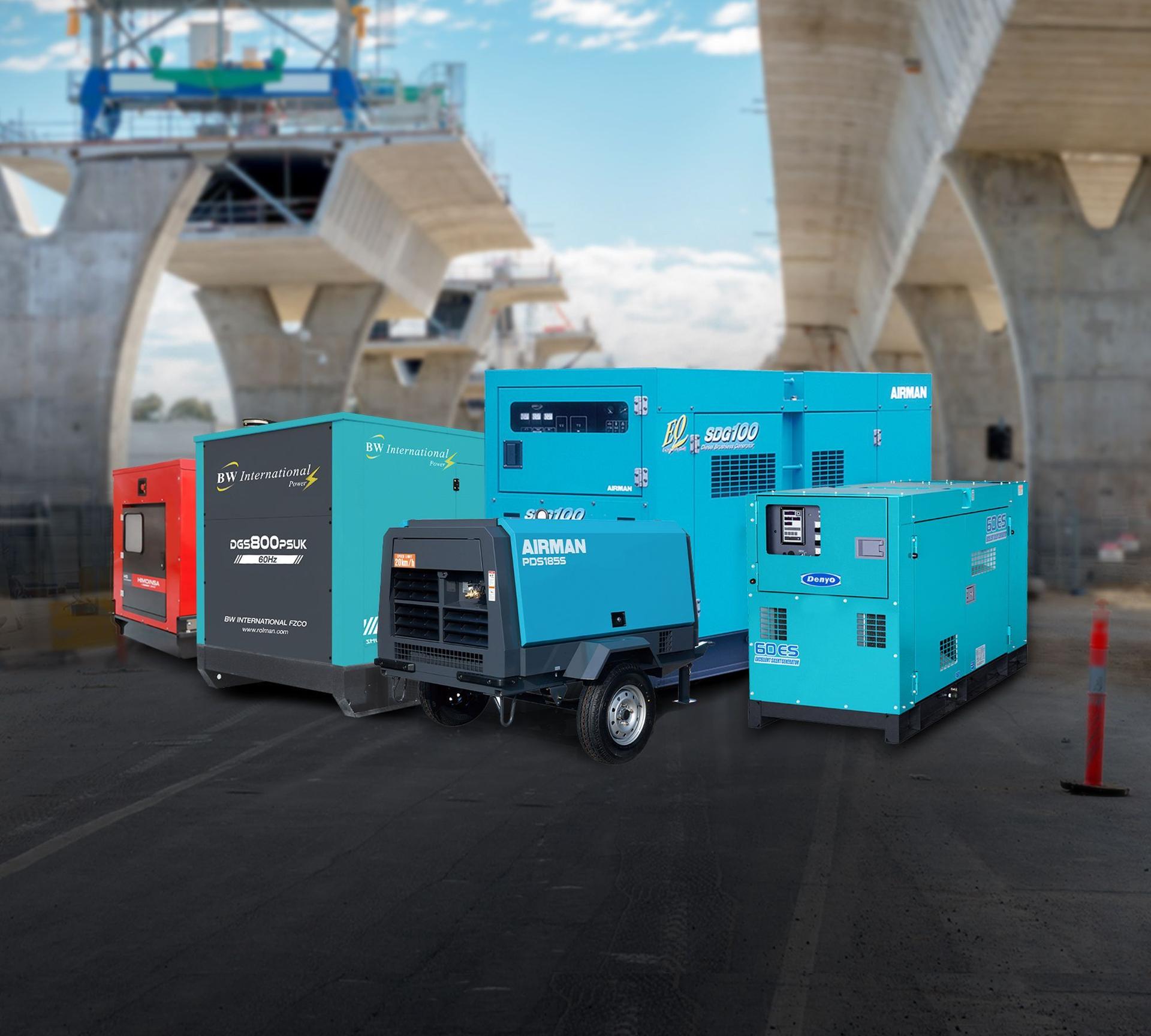
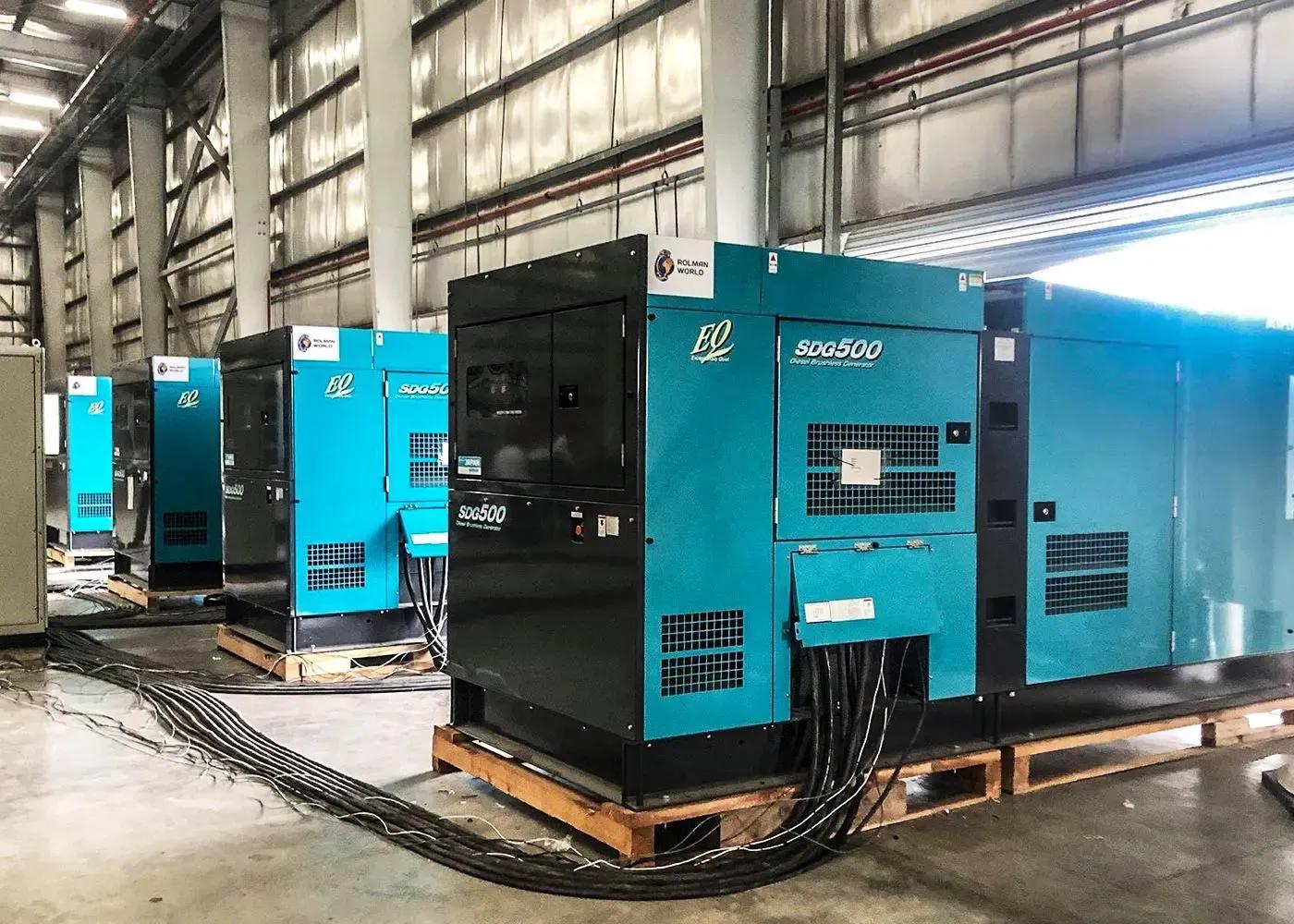
- Range. Make sure the supplier carries sets around the rating you need. At 50 Hz, our Denyo generators run from 10.5 to 1,000 kVA and our Airman generators from 10.5 to 700 kVA.
- Automatic voltage regulator (AVR). The AVR keeps the output voltage steady as the load changes, including during motor starts (Step 3). Denyo and Airman sets use brushless alternators with an AVR.
- Dual voltage. A dual voltage set can be switched to suit equipment rated at different voltages, one setting at a time. Both Denyo and Airman generators have a dual voltage system.
- Dual frequency. Generators are rated separately for 50 Hz and 60 Hz. The UAE runs at 50 Hz and Saudi Arabia at 60 Hz, so check that the set matches the country it will work in, or choose a dual-frequency model that can be switched between the two.
- Japanese engines. Denyo and Airman are both of Japanese origin, and their generators run on Japanese diesel engines from makers such as Komatsu, Kubota, Isuzu, and Mitsubishi.
- Suited to UAE heat. Sites in the UAE can exceed 50°C; in May 2025, the National Centre of Meteorology recorded 51.6°C at Sweihan. Check that the model is suited to the peak temperature on your site, and that wherever it sits has enough airflow for combustion and cooling, especially indoors or in a plant room.
Choosing a diesel generator supplier in Dubai
The supplier decides how well the set serves you over its working life.
- Will they check your sizing? A good supplier asks for your load list and works through it with you, including motor starting and site temperature.
- Are they authorised for the brands they sell? Ask for proof of authorisation from the manufacturer. It confirms the set comes through the manufacturer’s own network.
- Do they hold parts locally? Filters, belts, and common spares should be available in the UAE, not ordered from abroad when the set is already down.
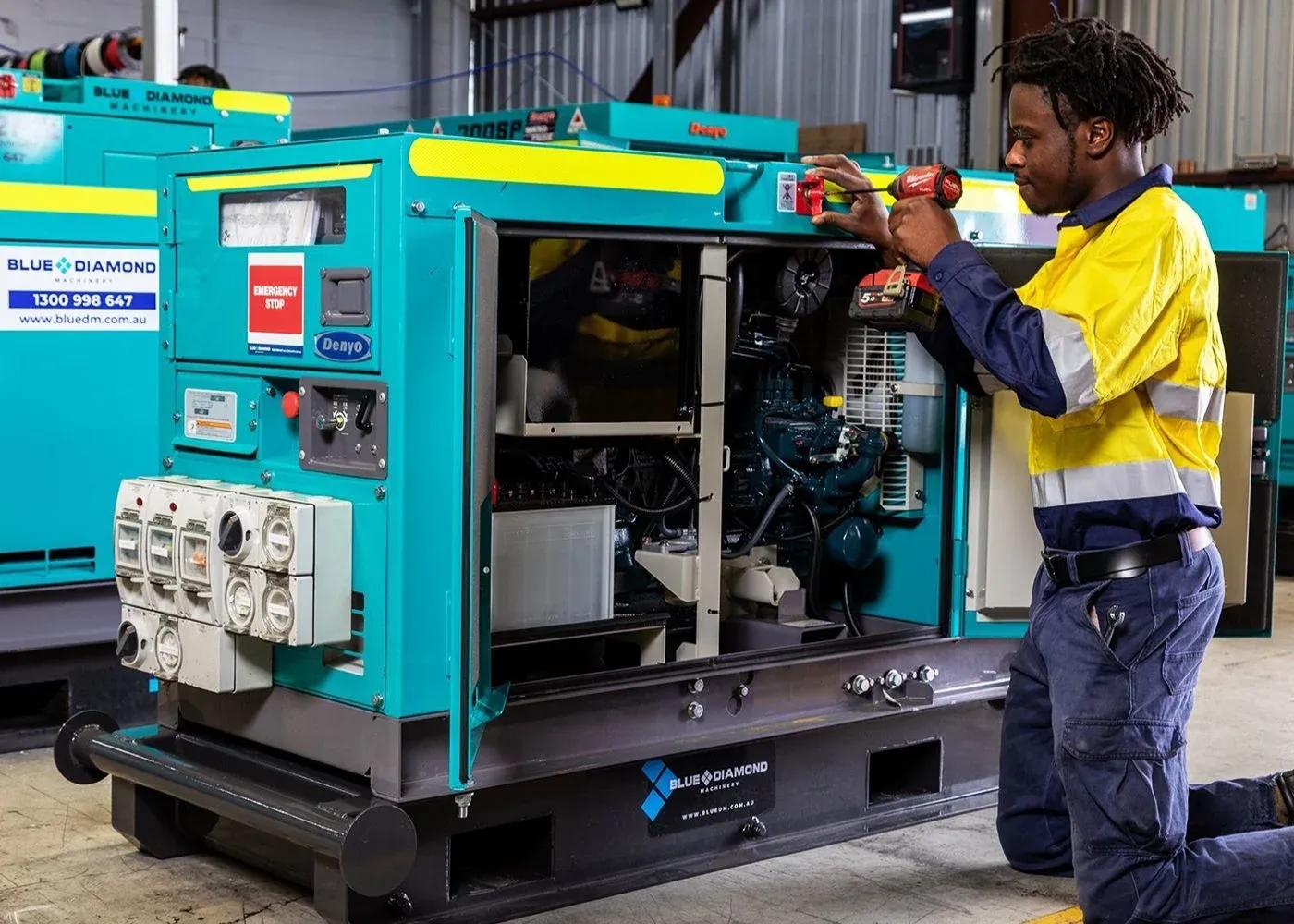
- Who commissions the set? Commissioning covers installation checks, a load test and setting up the controller. It’s often where sizing problems first show up, so it should be done by the supplier or someone they authorise.
- What does the warranty cover, and who carries out the service? Get the terms in writing, including the service intervals.
- Can they deliver and support beyond Dubai? If your projects move across the GCC, your supplier’s reach should match.
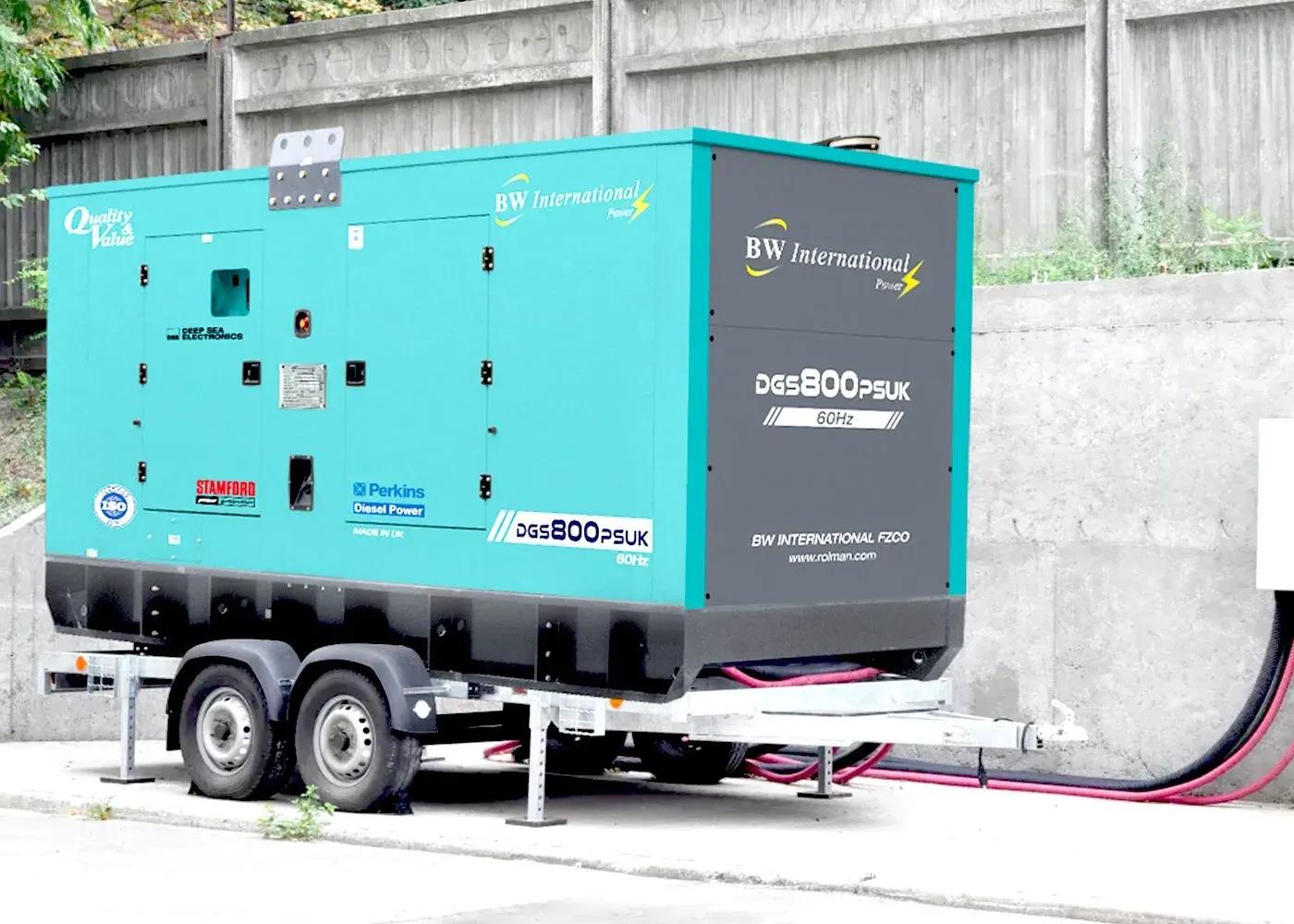
As a diesel generator supplier in Dubai, we distribute our own BW International generators, built with Perkins diesel engines and Stamford alternators. We’ve also distributed Denyo generators since 2013 and Airman generators since 2017, both of Japanese origin, in the markets where we’re authorised. Additionally, we support buyers with sizing, commissioning, parts, and after-sales.
Get your generator sized by Rolman
Knowing how to size a diesel generator gets you to the right range. A check against your real load list confirms it before you commit to a set.
Send our Power Generation team your load list and we'll review the sizing with you. To get a useful answer, include:
- Each item of equipment and its running kW
- Which loads are motors, and how each one starts
- The site temperature and whether the set sits in a canopy or plant room
- Whether the site has mains power, and the hours you expect to run
- The country of delivery
If your site also needs compressed air, our guide on how to choose an industrial air compressor covers the same ground for compressors.
Frequently Asked Questions
01. What size generator do I need for a construction site?
The size depends on your running load, the largest motor that starts, and how the set will be used. As a first estimate, divide the running load in kW by 0.8 to get kVA, then divide by 0.7 for a prime-rated set. A site running 92 kW needs a set of about 165 kVA.
02. How do I convert kW to kVA?
Divide kW by the power factor to get kVA. Three-phase generators are rated at a power factor of 0.8, so kVA = kW ÷ 0.8 and kW = kVA × 0.8. A load of 80 kW needs 100 kVA, and a 250 kVA generator delivers 200 kW.
03. What is the difference between standby and prime power?
Standby power is for backup when mains power fails, and the set runs only for a limited number of hours a year. Prime power is for sites with no mains supply and allows unlimited hours. Prime sets should run at an average load of no more than about 70% of the rating.
04. Is it bad to run a diesel generator on a light load?
Yes, if it happens for long periods. Engine makers advise against running a diesel generator below about 30% of its rated output for extended periods. At light load, the engine runs too cool to burn fuel completely, and unburnt fuel and soot build up in the cylinders and exhaust. This is called wet stacking.

Play Video