Bearings are among the smallest yet most critical components in a machine, and the performance of the whole machine depends on them. When a bearing isn't suited to the load, speed, or alignment of its application, it wears out well before its expected service life, and the failure that follows often damages the shaft and housing and brings production to an unplanned stop. Knowing the main types of bearings, and what each one is built for, is how you avoid that.
This guide explains the main types of bearings and the applications each one suits, and then sets out how to choose the right bearing for your equipment, including for the operating conditions found across the UAE and the wider GCC.
Quick answer: the main types of bearings
There are five main families of bearings.
- Ball bearings: balls running between two rings. They suit high speeds and light to moderate loads. The deep groove ball bearing is the most common type of rolling bearing.
- Roller bearings: rollers instead of balls, so each one touches the ring along a line rather than at a point. They carry heavier loads but run at lower speeds.
- Thrust bearings: built to take axial load along the shaft rather than across it.
- Plain bearings: no rolling elements, just a sliding surface. They suit slow, heavy, or shock loads.
- Linear motion bearings and guides: for straight-line travel rather than rotation.
The right choice comes down to six factors: load, speed, misalignment, space, temperature, and sealing.
How bearings carry load: radial, axial, and combined
A bearing carries load in one of three directions:
- Radial load acts at right angles to the shaft. It is the load a bearing carries when a belt pulls on a motor pulley, or when the weight of a conveyor drum rests on its shaft.
- Axial load, which is also called thrust load, acts along the line of the shaft. The weight of an impeller on a vertical pump shaft places an axial load on the bearing, as does a helical gear, which pushes along the shaft as its teeth mesh.
- Combined load is a radial and an axial load acting at the same time, and it is common in practice. A car wheel is a familiar example because the weight of the vehicle presses down on the bearing while cornering pushes the wheel sideways.
The direction matters because each bearing type is built to carry load along a particular path, and a bearing chosen for the wrong direction can fail early even when it has been generously sized. The next section shows which types suit which load.
Types of bearings and their uses
Bearings differ in their rolling element, which may be a ball, a roller, or none at all, and in the shape of the raceways it runs in. Together, these two features determine the load, speed and misalignment each type can handle. Manufacturers such as NSK classify rolling bearings on the same basis.
We also supply bearings from the brands we're authorised to distribute and from our own BW Bearings range.
Ball bearings
Most ball bearings fall into three types.
Deep groove ball bearings are the default choice for general machinery. Their raceways are deep enough to carry radial load and a moderate amount of axial load in both directions. You'll find them in electric motors, pumps, fans, and small gearboxes. They come open, shielded, or sealed, which matters a great deal in dusty conditions (more on that below).
Angular contact ball bearings have raceways offset at an angle. This lets them carry combined radial and axial load, but the axial load can only go in one direction. That's why they're usually mounted in pairs, facing each other or back to back. Machine tool spindles, centrifugal pumps, and compressors rely on them.
Self-aligning ball bearings have two rows of balls and a curved outer raceway, so the inner ring can tilt slightly without damaging the bearing. They suit long shafts that bend under load or housings that can't be aligned perfectly, such as agricultural machinery and textile equipment.
Roller bearings
There are four main roller bearing types.
Cylindrical roller bearings carry heavy radial loads at relatively high speeds. Most designs take little or no axial load, though some versions (with flanges on both rings) accept a small amount. Large electric motors, gearboxes and rolling mills use them.
Tapered roller bearings use cone-shaped rollers, so they carry heavy radial and axial load together. Like angular contact ball bearings, they take axial load in one direction only and are normally fitted in pairs. Their clearance can be adjusted during fitting. They're the standard choice for truck wheel hubs, differentials and gearboxes.
Spherical roller bearings have two rows of barrel-shaped rollers and a curved outer raceway. They combine very high load capacity with tolerance for misalignment. That's why you'll find them in crushers, vibrating screens, conveyors and fans in cement plants and quarries.
Needle roller bearings use long, thin rollers that carry a high load in very little radial space, which is why they are used in automotive transmissions, universal joints, rocker arms and compact gearboxes. We supply needle roller bearings from IKO, a brand we've been authorised to distribute since 1998.
Thrust bearings
Thrust bearings carry load along the shaft, and they come in two main forms. Thrust ball bearings suit light loads at low to moderate speeds and are used in crane hooks, turntables and swivels, while thrust roller bearings, which may be cylindrical, tapered or spherical, handle much heavier loads.
Because most thrust bearings can take very little radial load, they are installed alongside a radial bearing. The spherical roller type is the exception, since it also tolerates misalignment and accepts some radial load, which is why it is used in vertical pumps, extruders and large gearboxes.
Plain bearings
Plain bearings have no rolling elements, and the load is carried by one surface sliding against another, which makes them well suited to shock loads, slow speeds and oscillating movement. One of the most widely used forms in industrial and off-highway equipment is the spherical plain bearing, in which a curved inner ring swivels inside a matching outer ring, so the bearing can carry load while the parts it connects move out of line with each other.
Rod ends apply the same principle to linkages, with the bearing built into a threaded body so that it can be fitted to the end of a rod or actuator. Both forms are used in vehicle suspension and steering linkages, hydraulic actuators, conveyor systems and agricultural equipment. Unless they are of a self-lubricating design, they need regular greasing.
Linear motion bearings and guides
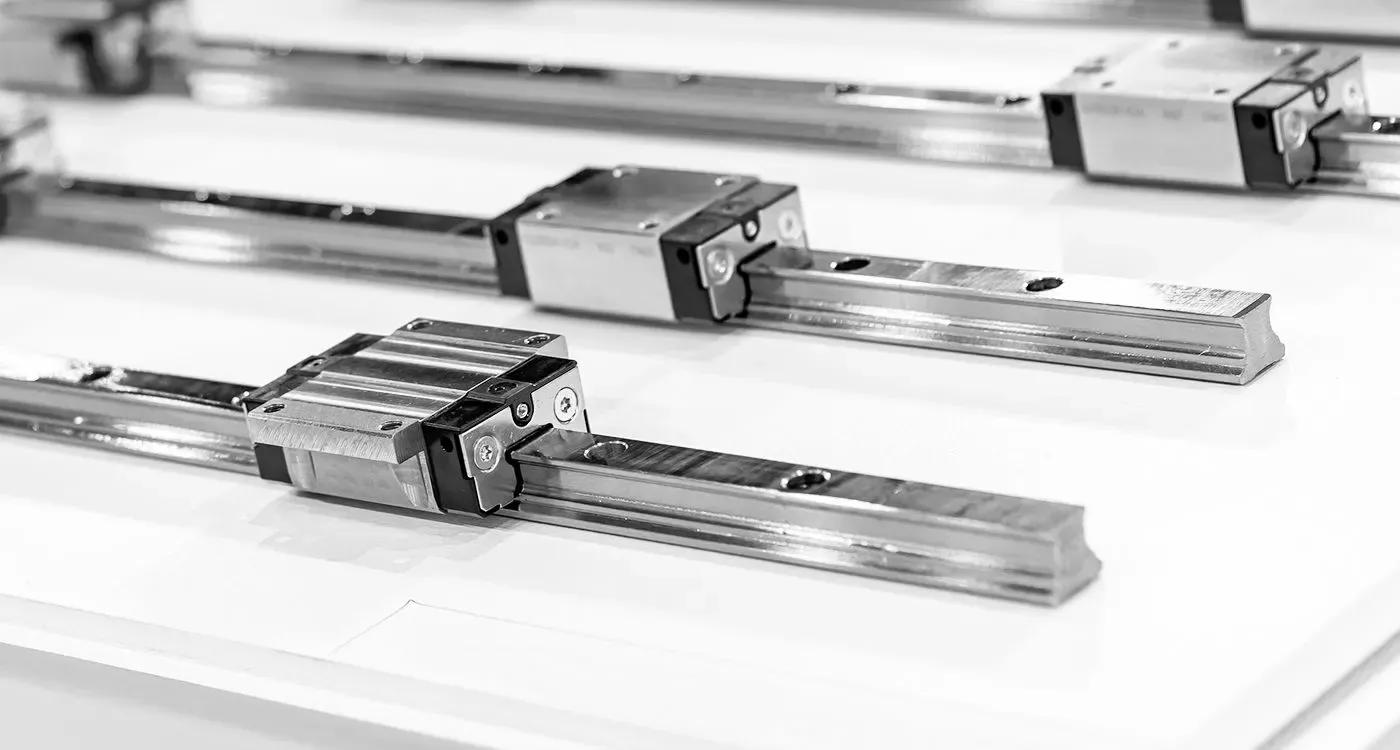
Linear motion bearings guide a carriage along a straight path, and they do it accurately, under load and over millions of cycles.
The two most common forms are linear guides and linear bushings. In a linear guide, a block runs along a hardened rail on recirculating balls or rollers. Linear bushings run along a round shaft on recirculating balls. Guides are rigid and precise enough for CNC machine tools, automated assembly lines, packaging machines, and inspection equipment. Bushings are a simpler option for lighter, less demanding motion.
We're an authorised distributor for THK and IKO in selected markets, and we supply their linear guides and bushings through our range of linear motion products.
Ball bearing vs roller bearing: the comparison table
The ball bearing vs roller bearing question comes down to how each one makes contact with the raceway. A ball touches it at a single point, which allows higher speeds and cooler running but limits the load, whereas a roller touches it along a line, which allows a heavier load at a lower speed. The table below compares the main types on this basis.
| Bearing type | Load it carries | Speed | Misalignment tolerance | Typical uses |
|---|---|---|---|---|
| Deep groove ball | Radial, light axial both ways | High | Very low | Electric motors, pumps, fans |
| Angular contact ball | Combined, axial one way | High | Very low | Spindles, pumps, compressors |
| Self-aligning ball | Radial, light axial | Moderate to high | High | Long shafts, agricultural and textile machinery |
| Cylindrical roller | Heavy radial, little or no axial | High | Very low | Large motors, gearboxes, rolling mills |
| Tapered roller | Heavy combined, axial one way | Moderate | Low | Wheel hubs, differentials, gearboxes |
| Spherical roller | Very heavy radial, moderate axial | Moderate | High | Crushers, vibrating screens, conveyors |
| Needle roller | Heavy radial for its size | Moderate to high | Very low | Transmissions, universal joints, compact gearboxes |
| Thrust ball | Light axial only | Low to moderate | None | Crane hooks, turntables |
| Spherical roller thrust | Very heavy axial, some radial | Low to moderate | High | Vertical pumps, extruders |
| Plain (spherical plain) | Heavy and shock, oscillating | Low | High | Excavator pivots, hydraulic cylinders |
| Linear guide | Loads across the rail | N/A (straight-line travel) | None | CNC machines, automation, packaging |
Bearings in vehicles and off-highway machines
Cars, trucks, and construction machines use the same bearing families as a factory, arranged for very different conditions: constant vibration, shock loads from the road, and long hours between services. Here are the main automotive bearing types and where you'll find them.
Wheel bearings and hub units. Most modern passenger cars use a double-row angular contact ball bearing, often built into a complete hub unit. Later generations add the mounting flange and the ABS sensor ring, so the whole assembly is replaced as one part. Trucks, buses, and heavy vehicles generally use pairs of tapered roller bearings instead, because they carry far heavier loads and can be adjusted during fitting. These are the two wheel bearing types a parts buyer meets most often.
Clutch release bearings take the axial load each time the clutch pedal is pressed.
Alternator and idler pulley bearings are sealed deep groove ball bearings, and water pumps use a sealed integral shaft bearing. All of them run fast under belt load and can't be relubricated.
Steering and strut bearings carry the car's weight while letting the suspension and steering turn.
Transmission bearings mix needle, tapered, and ball bearings, chosen for the space and load at each point.
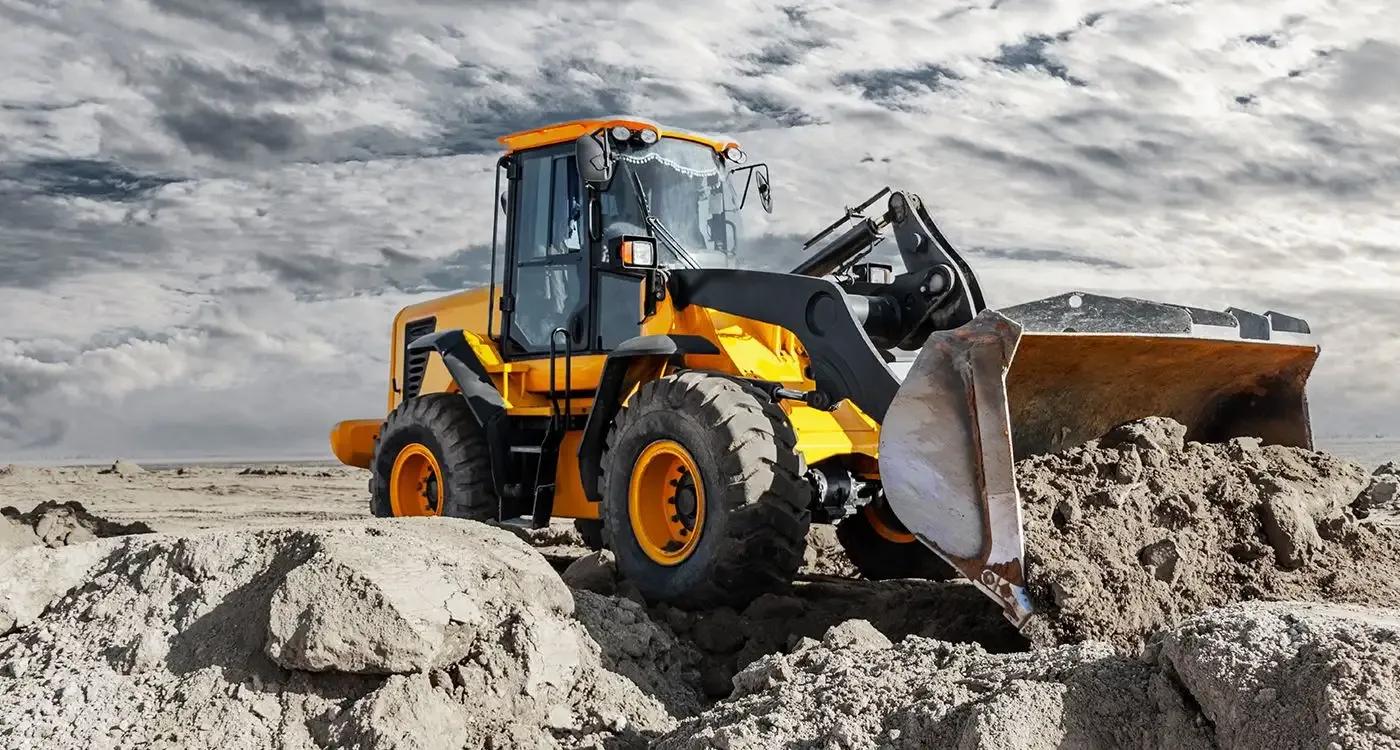
Off-highway machines push the same parts harder. Excavator and loader axles rely on tapered roller bearings, and their pivot points use spherical plain bearings. The upper structure turns on a large slewing ring bearing.
How to choose a bearing in 6 steps
Work through these factors in order, and each one narrows the choice for your equipment.
01 Load and direction
Start with how heavy the load is and which way it pushes. Light to moderate radial load points to a ball bearing. Heavy radial load points to a roller bearing. Combined load needs an angular contact ball or tapered roller bearing, and pure axial load needs a thrust bearing. Manufacturers' catalogues give each bearing a dynamic load rating, which is used to calculate L10 life: the life, in revolutions or operating hours, that 90% of identical bearings are expected to reach before fatigue damage appears.
02 Speed
Every bearing has a limiting speed in the catalogue. Ball bearings run fastest, cylindrical rollers come next, and tapered and spherical rollers run slower. If your shaft speed is close to the limit, move to a lighter series or a ball bearing.
03 Misalignment and shaft deflection
Ask whether the shaft and housing will stay perfectly in line. Long shafts bend, welded frames distort, and housings bolted to separate bases rarely line up exactly. If any of that applies, choose a self-aligning ball or spherical roller bearing. Rigid types such as deep groove and cylindrical roller bearings wear quickly when forced to run out of line.
04 Space and mounting
Check the room available around the shaft. Where radial space is tight, needle roller bearings carry a heavy load in a thin section. Where there's no machined housing at all, a mounted unit (a bearing supplied inside its own bearing housing) bolts straight onto the frame.
05 Temperature and contamination
Heat changes how a bearing fits. When the shaft runs hotter than the housing, as it does in an electric motor, the inner ring expands and takes up the internal clearance. A bearing with greater-than-normal clearance (marked C3) allows for that. Dust, water, and process material matter just as much, and they decide the next step.
06 Sealing and lubrication
Open bearings rely on the housing's seals and need regular relubrication. Shielded bearings (ZZ) keep out larger particles with very little added friction. Sealed bearings (2RS) use rubber contact seals that keep out fine dust and moisture, with slightly more friction and a lower speed limit. Sealed and shielded bearings are supplied pre-greased and generally aren't relubricated in service, so the seal choice also sets the maintenance routine.
For the most common cases, the decision comes down to this:
- High speed, light to moderate load → deep groove ball bearing
- Heavy radial load with misalignment → spherical roller bearing
- Combined radial and axial load → tapered roller or angular contact ball bearings, fitted in pairs
- Heavy radial load in a tight space → needle roller bearing
- Axial load only → thrust bearing
- Slow, oscillating or shock load → plain bearing
How to read a bearing number
A bearing number is a code for the bearing's type, size, and features. Take 6204-2RS C3:
- 6 is the bearing type: a single-row deep groove ball bearing.
- 2 is the diameter series, which sets how heavy the section is for a given bore.
- 04 is the bore code. For codes 04 and above, multiply by 5 to get the bore in millimetres: 04 × 5 = 20 mm.
- 2RS means a rubber contact seal on both sides. ZZ (or 2Z) would mean a metal shield on both sides.
- C3 means the internal clearance is greater than normal.
So a 6204-2RS C3 is a sealed deep groove ball bearing with a 20 mm bore, a 47 mm outside diameter, and a 14 mm width, with extra internal clearance.
The basic number is standardised, so a 6204 has the same dimensions from any manufacturer. Suffixes aren't. NSK, for example, marks contact seals as DDU rather than 2RS. Check the manufacturer's designation guide before you treat two part numbers as equivalent.
Choosing bearings for UAE and GCC conditions
The types of bearings UAE plants and fleets use are the same as anywhere else, but the operating conditions are harsher. Three of them affect the choice.
Heat. High ambient temperatures push a bearing’s running temperature up, and grease thins and ages faster as it gets hotter. Check that the grease is rated for the actual operating temperature, which in the GCC may be higher than the original equipment manual assumes. High ambient heat also makes the C3 clearance from step 05 more important, not less.
Sand and dust. Fine airborne sand gets past a metal shield, so for exposed equipment such as conveyors, crushers, fans and site machinery, the contact seals (2RS) from step 06 are the safer default. On larger housed bearings, extra housing seals help keep the grit out.
Coastal humidity. Much of the region's industry is located near the coast, where humid, salty air causes corrosion, particularly in machines that are left idle. Sealed bearings help, and so does storage. Keep spares in their original packaging until the day they're fitted.
Lubrication in GCC conditions. Heat and dust both shorten relubrication intervals, and that is where automatic lubrication systems help. They feed small amounts of fresh grease at set intervals, which avoids the friction and heat that come from too little or too much grease, and the steady flow purges grit from the seals. Exact temperature limits and relubrication intervals depend on the bearing, the grease, and the duty, so take them from the manufacturer's data for your specific part.
Bearing failure analysis: what a failed bearing tells you
A failed bearing usually shows why it failed. Bearing failure analysis means reading the marks on its raceways and rolling elements before a replacement goes in, so the new bearing doesn’t fail the same way. Inspect it before cleaning, because the deposits are part of the evidence.
| What you see | Likely cause |
|---|---|
| Blue or brown discolouration | Overheating, from lubrication failure or a fit that’s too tight |
| Wear path running off-centre across the raceway | Misalignment |
| Dents spaced like the rolling elements | Impact during fitting, or a shock load |
| Washboard pattern of fine ridges (fluting) | Electric current through the bearing, often in motors on variable frequency drives |
| Rust or corrosion pits | Moisture, from humid air or poor storage |
| Dull, scratched surfaces | Contamination such as sand or dust |
Once the cause is known, the fix usually lies in one of the selection steps above.
Genuine bearings matter
Choosing the right type only helps if the bearing in the box is what the label says it is. Counterfeit bearings carry the same markings and part numbers as genuine ones, but nothing guarantees their steel, heat treatment, or tolerances. The load ratings in the catalogue don't apply to them.
The reliable safeguard is the supply chain. The World Bearing Association, whose members include NSK, Timken and other leading manufacturers, advises buying from a trusted source. Buy from a distributor the manufacturer has authorised, and ask for proof of that authorisation. We've distributed NSK bearings since 1971 and have been an NSK Master Distributor since 2000, in the markets where we hold that authorisation. Our guide on how to choose a reliable bearing supplier covers what to check.
Find the right bearing with Rolman World
Once you know the main types of bearings and the questions to ask, most selections are quick. The table narrows the type. Load, speed, alignment, space, environment, and sealing settle the details.
If you'd like a second opinion, or you're replacing a bearing and want to confirm the match, send our team the details. A specific enquiry gets a more useful answer, so include:
The bearing number, including any suffix
- The application and operating conditions (speed, temperature and contamination)
- Shaft and housing fitting tolerance
- The quantity and preferred brand
- The country of delivery
We'll help you match the right bearing for the job.
Frequently Asked Questions
01. What are the main types of bearings?
The main types of bearings are ball bearings, roller bearings, thrust bearings, plain bearings, and linear motion bearings. Ball and roller bearings carry mainly radial or combined loads. Thrust bearings carry axial loads, plain bearings slide instead of roll, and linear bearings guide straight-line movement.
02. What is the most common type of bearing?
The deep groove ball bearing is the most common type of bearing. It carries radial load and some axial load in both directions, runs at high speed, and needs little maintenance. That combination makes it the standard choice for electric motors, pumps, fans, gearboxes, and household appliances.
03. What is the difference between ball and roller bearings?
Ball bearings use balls that touch the raceway at a point, while roller bearings use rollers that touch along a line. Point contact gives ball bearings lower friction and higher speeds. Line contact lets roller bearings carry heavier loads and absorb shock better, but at lower speeds.
04. Which bearing is best for heavy radial loads?
Cylindrical and spherical roller bearings are best for heavy radial loads. Choose a cylindrical roller bearing when the shaft is well aligned, and the speed is high. Choose a spherical roller bearing when the load is very heavy, or the shaft may be misaligned, as in crushers, conveyors, and vibrating screens.
05. What do bearing numbers like 6204-2RS mean?
A bearing number describes the bearing's type, size, and features. In 6204-2RS, 6 means a deep groove ball bearing, 2 is the dimension series, and 04 means a 20 mm bore (04 × 5). The suffix 2RS means rubber seals on both sides. Suffixes vary between manufacturers, so check their designation guide.
06. Which bearings are used in car wheels?
Most passenger cars use double-row angular contact ball bearings in their wheels, usually built into a sealed hub unit. Trucks, buses and heavy vehicles generally use pairs of tapered roller bearings, which carry heavier loads and can be adjusted during fitting. Both types handle the combined radial and axial load a wheel produces.